
Privacy and data
What the plugin stores, what it sends to other services, and what appears in your site’s public markup. Everything here is verified against the plugin code as of version 1.0.0; open questions are listed at the end.
What the plugin stores on your site
Section titled “What the plugin stores on your site”- Posts and post meta. All content lives in regular WordPress posts and post meta (meta keys prefixed
_postkind_). The plugin creates no custom database tables. - Check-in location data. Check-ins store venue details, latitude/longitude, and a per-post
geo_privacyvalue (public / approximate / private). Depending on the Coordinate Handling setting, coordinates can also be rounded to ~1 km before storing or discarded entirely. - Options. Settings, import history/state, webhook secrets and logs, and API credentials are stored in the WordPress options table. Credentials include API keys and OAuth access/refresh tokens (Trakt, Simkl, Foursquare, Last.fm session key). Keys and tokens are stored as plugin options in the database; this documentation makes no encryption claim (the plugin readme’s “encrypted where possible” wording is flagged for maintainer review below).
- Transients for cached API responses (clearable from Settings → Tools).
- Taxonomies. The plugin adds the
kindtaxonomy (with 36 terms) and avenuetaxonomy with term meta (Foursquare/OpenStreetMap ids, coordinates). It can also register areactionpost type if the import storage mode is switched from its default. - Scheduled tasks (WP-Cron) for background imports and syncs.
On uninstall (deleting the plugin from the Plugins screen), the uninstall routine deletes all plugin options — including API credentials, OAuth tokens for each service, webhook secrets and logs — plus plugin transients, and unschedules its cron events. Your posts, meta, and taxonomy terms remain, since they’re your content.
Check-in location privacy
Section titled “Check-in location privacy”Each check-in has a privacy level (per post, with a site default under Settings → Checkin), and the plugin enforces it in the public microformats markup:
- Public — full venue name, street address, and exact coordinates appear in the markup.
- Approximate — locality/region/country appear; street address and coordinates are withheld.
- Private — the location is stored in your database but venue, address, and coordinates are all withheld from the public page.
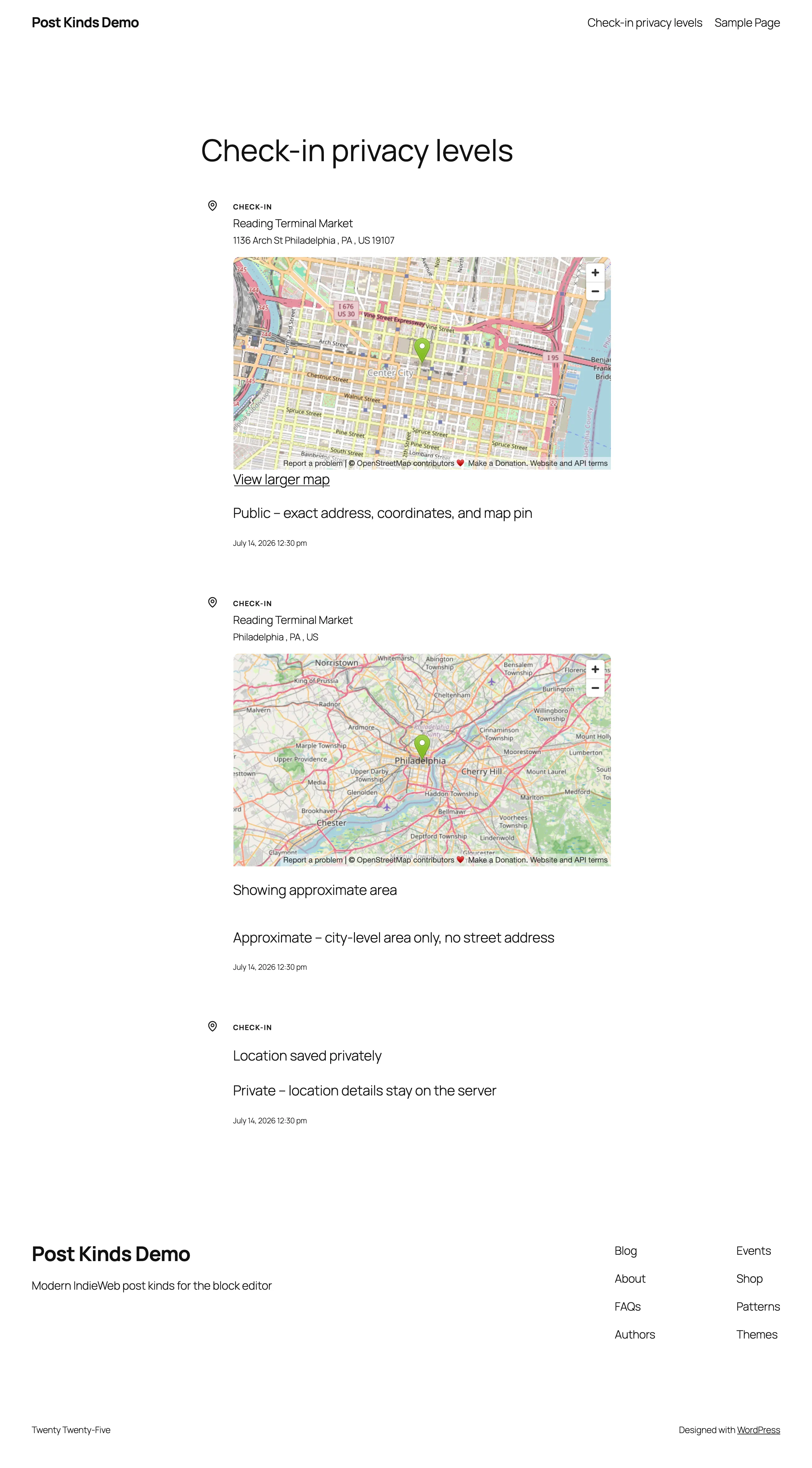
Separately, Coordinate Handling governs storage itself: store-and-show, store-but-hide, round to ~1 km, or discard coordinates entirely (discarded coordinates can’t be recovered later).
What the plugin sends to external services
Section titled “What the plugin sends to external services”Lookups, imports, and scrobble ingestion. When you search for media, import history, or auto-fetch metadata, the plugin makes outbound requests to the relevant service. Services present in the plugin’s code:
- Music: MusicBrainz, ListenBrainz, Last.fm, Cover Art Archive
- Movies/TV: TMDB (including its image host), Trakt, Simkl, TVmaze
- Books/articles: Open Library (including covers), Google Books, Readwise
- Podcasts: Podcast Index
- Games: RAWG, BoardGameGeek/VideoGameGeek
- Places: Foursquare, Nominatim (OpenStreetMap)
- Other: Untappd (code present; its API currently requires a commercial agreement), and oEmbed providers (YouTube, Spotify, and similar) for embeds
- Letterboxd page fetches: pasting a Letterboxd URL into a watch lookup makes the plugin fetch that Letterboxd page’s HTML to extract the film’s TMDB id — an outbound request to letterboxd.com worth knowing about.
- Amazon Kindle previews: when a read post embeds a Kindle book preview, the preview frame loads in the browser — yours in the editor, your visitors’ on the published post — directly from read.amazon.com with the book’s ID in the URL. The plugin’s server sends nothing to Amazon; the request comes from whoever views the post, so Amazon sees their IP address the same way any embedded frame’s host does.
These requests carry your search terms or media identifiers (and your API credentials for that service). The plugin readme states API calls retrieve only public metadata and that the plugin includes no analytics or tracking.
Standard.site record lookups. When you press Check this URL in a card block’s sidebar, or a few seconds after you publish a post whose card cites a URL, the plugin follows a chain of up to three requests:
- The cited page itself, to read its
site.standard.documenttag. An ordinary request for a URL you already linked to. - plc.directory, to turn the identifier in that tag into the address of the server holding the record. Operated by Bluesky Social PBC. Skipped for
did:webidentifiers, which name their own host instead. - That server, to read the record.
No credentials are involved at any step, and nothing about you or your site is sent beyond what any HTTP request carries.
The third host is the part worth understanding: it is not a fixed service. It is whichever Personal Data Server the author of the page you cited happens to use, so which hosts get contacted depends entirely on which pages you bookmark. All three requests use wp_safe_remote_get(), which will not follow a URL into your own network.
Results are cached for a day, misses included, so a page is not re-fetched on every save. Nothing is contacted for a card with no URL, and a page that turns out not to be on AT Protocol costs one request, not three.
Only the resolved record’s address is stored, in the _pkiw_standard_site_uri post meta key, and only when the record verifies against the page it was found on.
POSSE syndication (outbound publishing). The plugin sends your activity to Last.fm, Trakt, or Foursquare only when you enable the matching toggle (Scrobble to Last.fm, Sync to Trakt, Sync to Foursquare). All three default to off.
Webhooks (inbound). Plex, Jellyfin, Trakt, ListenBrainz, and generic webhooks push data to your site; deliveries are verified with an HMAC-SHA256 signature against your webhook secret.
AI features. AI enhancements (auto-populate, tag suggestions, review prompts) are doubly gated: they require the WordPress AI Client (WordPress 7.0+) to be available and the plugin’s AI option to be enabled. When active, they send media metadata to whichever AI provider your site’s WP AI Client is configured to use. Exactly what is sent, and to which provider, depends on that site-level configuration — see the maintainer-review list below.
Standard.site publishing (through ATmosphere)
Section titled “Standard.site publishing (through ATmosphere)”This section applies only when the optional ATmosphere companion plugin is installed. Once you connect an AT Protocol account there, eligible published posts are written to your Personal Data Server as public site.standard.document records — title (including the titles Post Kinds derives for untitled kinds), your post’s address, publish date, excerpt, plain-text content, tags (including the kind), and the featured image. These records live outside your WordPress database, on your PDS, and propagate to public AT Protocol indexers. Unpublishing, trashing, or deleting a post removes its record through ATmosphere; disconnecting stops publishing but leaves existing records on your PDS until removed.
What Post Kinds controls on top of ATmosphere’s own eligibility rules:
- Thin signal kinds (likes, reposts, favorites, follows, tags) and privacy-sensitive kinds — check-ins, moods, wishes, acquisitions, weather, exercise, sleep, trips, itineraries — never publish unless you turn them on, per kind or per post. Public logs (listens, watches, reads, plays, eats, drinks, jams) publish by default, carrying only what their public pages already show.
- A check-in that does publish follows your existing check-in privacy setting: a private check-in’s derived title is just “Checked in”, and the record’s text comes from the same privacy-filtered rendering your site shows. Eat and drink posts have optional venue fields with no equivalent privacy tier — whatever venue detail the public card shows is what the record carries.
- Drafts, scheduled, private, and password-protected posts never publish — that’s ATmosphere’s own gate, which Post Kinds narrows and never widens.
Credentials never touch this plugin: the AT Protocol connection, its tokens, and their encryption are ATmosphere’s alone.
Frontend markup
Section titled “Frontend markup”Yes, the plugin adds markup to your public pages: microformats2 classes on kind posts (h-entry roots, kind-<slug> post classes, properties like u-listen-of, u-checkin, p-rating), hidden <data> elements for RSVP/check-in/review/event details, and the rendered card/dashboard blocks themselves. Check-in markup is redacted per the privacy level described above. Posts using IndieBlocks blocks are left to IndieBlocks’ own microformats.
Other WordPress data the plugin touches
Section titled “Other WordPress data the plugin touches”- Posts: kind assignment on save (from the first card block, never overriding a manual choice), optional default category on first save, and optional post-format ↔ kind syncing.
- Post meta: card and location fields under
_postkind_, pluspkiw_promote(public, REST-visible) and_pkiw_surface(protected) for stream/main routing. The plugin never filters your site’s queries for surfaces — it only records the signal. - Media library: with the default “Download to Media Library” image handling, cover art from external services is sideloaded into your uploads.
- It does not modify comments, users, or links.
What was verified, and what needs maintainer review
Section titled “What was verified, and what needs maintainer review”Verified from code: options and meta storage, no custom tables, the uninstall cleanup list, privacy-level redaction in markup, the outbound hosts above, the POSSE and AI opt-in gates, and webhook signature verification.
Needs maintainer review (also listed in the documentation plan):
- “API keys encrypted where possible” (readme claim). The code stores credentials as sanitized plaintext values in the options table; no encryption path was found. The claim should be confirmed or softened by the maintainer — until then, assume keys are stored unencrypted and protect your database accordingly.
- AI data flows. The precise payload and destination provider depend on the site’s WP AI Client configuration and weren’t traced in full.
- ActivityPub. Listed in the readme as an optional companion; no code integration was found, so no data flows to it from this plugin as far as verified.